

making you awesome
ONE BLOG A AT TIME
Controversial Marketing: When Brand Backlash Helps—and When It Hurts
Everyone's Talking About Your Brand. Now What?
Getting people to talk about your brand has never been easier. Getting them to remember the right thing about your brand? That's becoming much harder.
Over the past year, we've watched campaign after campaign generate enormous attention because people couldn't agree on whether the marketing was brilliant, offensive, ridiculous or intentionally provocative.
That raises an interesting question for marketers: When did backlash become a KPI?
At 3131 Media, we love marketing that takes a risk. Safe creative can be forgettable creative. However, there's an important difference between creating something worth talking about and creating something because people will argue about it.
The internet rewards both. Your brand may not.
by Mattie Smith, Brand & Business Strategist
August 19, 2026
The American Eagle Effect
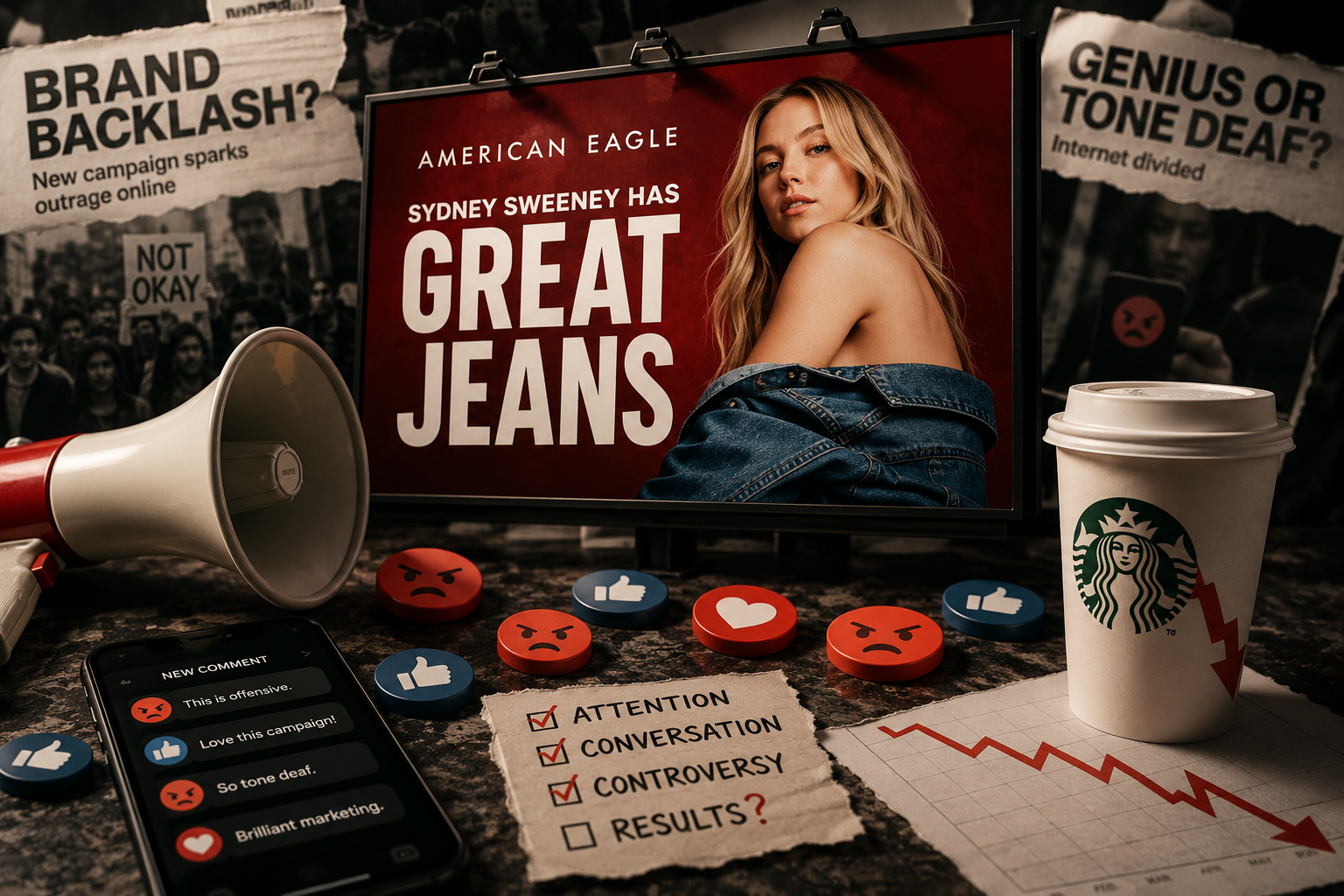
It's hard to talk about this trend without mentioning American Eagle. The brand's 2025 campaign featuring Sydney Sweeney centered around the line ‘Sydney Sweeney Has Great Jeans,’ playing intentionally with ‘jeans’ and ‘genes’. The campaign quickly became much bigger than denim, with online debate ranging from praise for the creative to criticism over its racial undertones.
Here’s where the story gets interesting for marketers…
The controversy didn't necessarily hurt the business. American Eagle later reported significant new customer acquisition following its Sweeney and Travis Kelce campaigns, while the Sweeney campaign generated extraordinary levels of attention.
So was it successful? Maybe. And that's exactly why this conversation is complicated.
If the objective was awareness, conversation and customer acquisition, there are strong arguments that it worked. It also demonstrates something brands need to understand: once you create provocative marketing, you don't get to decide what the internet makes it about.
Backlash That Creates Actual Damage
Not every controversy ends with record attention and new customers. Starbucks Korea learned that distinction in 2026.
A summer promotion drew outrage because elements of the campaign unintentionally evoked painful imagery and language associated with South Korea's pro-democracy history. The company halted the promotion, leadership changes followed, and Starbucks Korea subsequently reported a quarterly operating loss amid declining sales after the controversy.
That's a very different kind of viral moment. Both campaigns generated conversation. Only looking at mentions, impressions or engagement would miss almost everything that matters.
Attention Is a Metric. Meaning Is the Strategy.
This is where we think marketers need to be careful. Social platforms have conditioned us to celebrate anything that produces a spike:
More comments.
More shares.
More mentions.
More impressions.
But more isn't automatically better. A campaign can generate incredible engagement while weakening brand trust. Another can receive criticism from people who were never likely to become customers while strengthening its relationship with the audience that matters.
Those aren't the same outcome. That's why evaluating controversial marketing requires going beyond engagement. Ask: Who is talking about us? What are they saying? What are they remembering? Did the attention change how our target audience sees us?
And ultimately: Did it move the business forward?
Brands don't need controversy. They need a point of view. This distinction matters most.
Brands shouldn't be afraid of making people react. They should be afraid of making people react without knowing why they're doing it.
Strong brands have opinions. They make unexpected creative choices. They occasionally make some people uncomfortable. Those decisions should come from positioning, not an engagement strategy built around outrage. Because there's a big difference between:
"Some people won't like this, but it's exactly who we are”
versus
"People are going to be furious. Imagine the engagement."
One builds a recognizable brand. The other is rage bait with a media budget.
The 3131 Take
We're not entering an era where brands need to become more controversial. We're entering an era where forgettable marketing is increasingly expensive. That means taking creative risks, having a point of view, and understanding your audience well enough to know when to push and when not to.
Attention should never be the final objective because getting everyone to talk about your brand isn't particularly valuable if they walk away remembering the wrong thing.
Takeaway: Don't chase backlash. Build something worth reacting to.